01
New projects
A paragraph about the problem is enough to start. We reply within two working days, usually with questions rather than a quote.
Tokenization for funds and regulated assets: permissioned tokens, investor allow-lists, forced transfer for lost keys, and register reconciliation.
Tokenization represents ownership of a real-world asset — fund units, bonds, property, credit — as tokens on a blockchain. For regulated assets the hard part is not issuing the token. It is enforcing who may hold and transfer it, recovering units when a key is lost, and keeping the on-chain record in step with the legal register. We build the contracts and the systems around them.
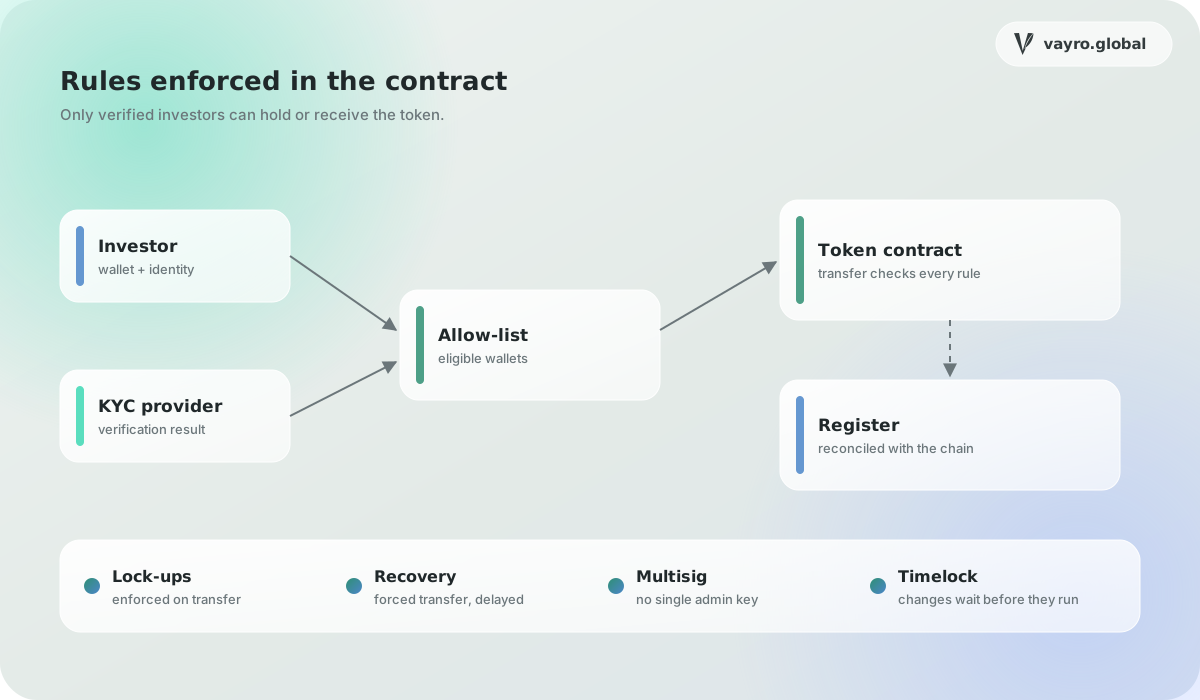
Tokens that check an allow-list on every transfer, with lock-ups and limits enforced in the contract rather than in an interface.
Connection to your KYC and accreditation provider so a wallet becomes eligible only after verification.
A controlled way to move units when a holder loses a key or a court orders it, behind multiple approvals and a delay.
A service that compares chain state to the book of record, survives chain reorganisations, and reports any difference.
Subscriptions, redemptions and distributions, with reporting a fund administrator and an auditor can follow.
We turn the transfer restrictions and investor rules into a written specification with your counsel.
Token, permission layer and admin roles, with invariants stated first.
Onboarding, reconciliation and reporting are built alongside the contracts, not after.
External audit, then a limited first issuance before opening wider.
A paragraph about the problem is enough to start. We reply within two working days, usually with questions rather than a quote.
Engineers, designers and researchers who like systems that are hard to get right. Send something you built and what you would change about it now.
Based in India and working remotely, with overlap hours agreed up front so your team always has a time to reach us.
Guides on AI agents, RAG, MCP, tokenization and chain abstraction, written by the engineers who build them.