01
New projects
A paragraph about the problem is enough to start. We reply within two working days, usually with questions rather than a quote.
Production AI agents built with scoped tool access, state that survives a retry, an evaluation suite from your real inputs, and a cost ceiling per run.
An AI agent is a language model that takes actions — it calls tools, reads the results, and decides what to do next until a task is finished. We design and build agents for production: the tools they may call, the state they keep between steps, the points where a person approves, and the tests that show the agent still behaves after every change.
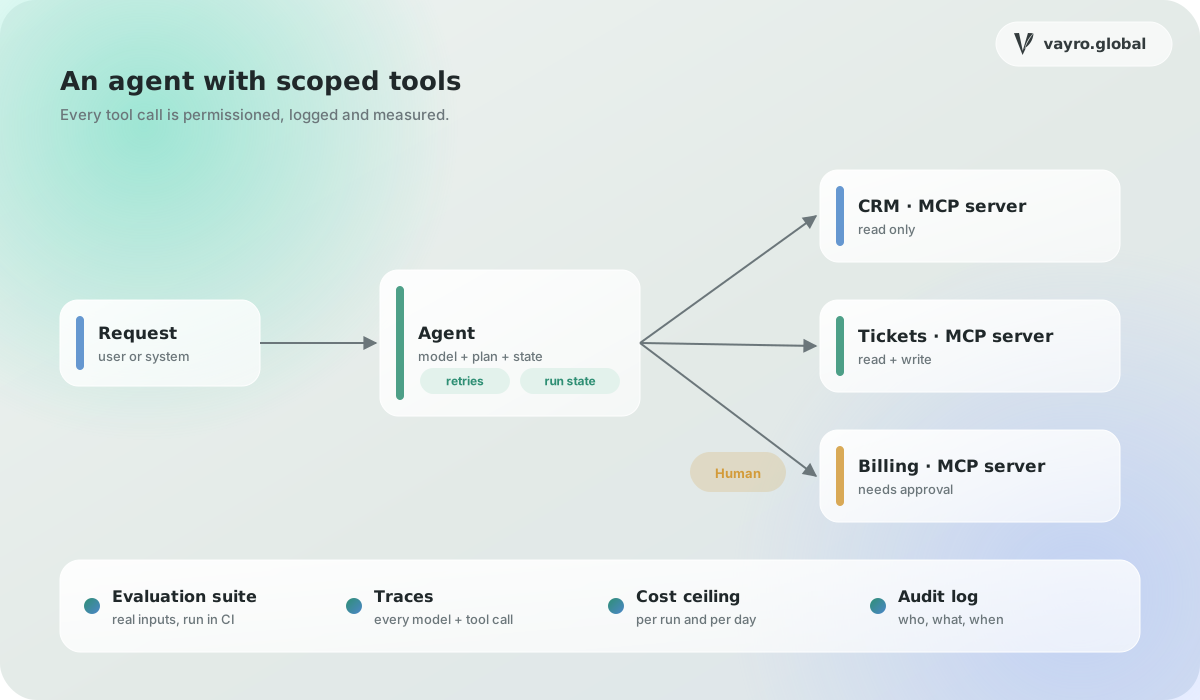
The smallest set of tools that completes the job, each with a narrow scope, a typed input, and an error shape the model can recover from.
Run state stored outside the model, idempotent tool calls, and resumable steps, so a timeout does not send the same email twice.
Anything that moves money, changes access, or contacts a customer stops for a person. Where that line sits is decided with you and written down.
Test cases built from your real historical inputs, scored on every pull request, so a prompt change that breaks an old case is caught before release.
A trace per run showing each model call and tool call, with a spend ceiling per run and per day that stops the agent rather than the invoice.
We write down what the agent must do, what it must never do, and how success is measured, using examples from your own data.
The test set exists before the agent does, so every later decision is scored rather than argued.
Tools are connected to a staging copy of your systems from the first week, not mocked until the end.
Shadow mode, then a small share of traffic with a person reviewing, then wider — each step gated on the evaluation score.
A paragraph about the problem is enough to start. We reply within two working days, usually with questions rather than a quote.
Engineers, designers and researchers who like systems that are hard to get right. Send something you built and what you would change about it now.
Based in India and working remotely, with overlap hours agreed up front so your team always has a time to reach us.
Guides on AI agents, RAG, MCP, tokenization and chain abstraction, written by the engineers who build them.