AI · Service LLM evaluation and observability

Evaluation suites built from your real inputs, a trace for every run, drift alerts and cost ceilings, so an AI feature is measured rather than assumed.

In short

LLM evaluation is the practice of testing an AI feature against a fixed set of real examples and scoring the results, so you know whether a change made it better or worse. Observability is seeing what each production run actually did. We build both: a regression suite that runs in CI, and traces, cost tracking and alerts for the live system.
Practice
AI
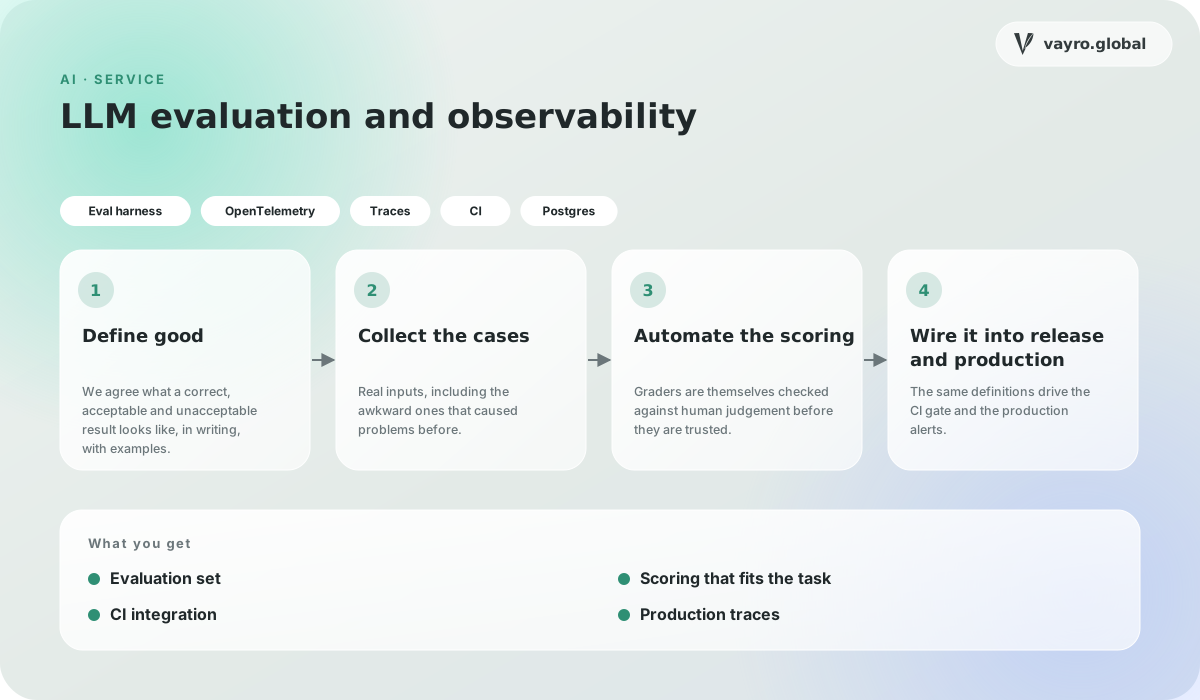
LLM evaluation and observability — how Vayro delivers it: Define good, then Collect the cases, then Automate the scoring, then Wire it into release and production. Includes evaluation set, scoring that fits the task, ci integration, production traces.
When you need it

Signs this is the right service

  • Nobody can say whether last week's prompt change improved things or broke something.
  • The feature is live and the first sign of a problem is a customer complaint.
  • Model costs are rising and it is unclear which feature or customer is responsible.
  • You want to change model or provider and need to know what you would lose.
What's included

What you get

Evaluation set

Cases drawn from your real historical inputs, with the expected behaviour written by the people who own the outcome.

Scoring that fits the task

Exact checks where there is a right answer, rubric-based grading where there is not, and human review for a sample.

CI integration

The suite runs on every pull request and blocks a release that scores below the agreed threshold.

Production traces

Each run recorded end to end — prompts, tool calls, latencies, tokens — and searchable when something goes wrong.

Cost and drift alerts

Spend per feature and per customer, with alerts when cost per run or answer quality moves outside its normal range.

How we deliver it

The process

  1. 01

    Define good

    We agree what a correct, acceptable and unacceptable result looks like, in writing, with examples.

  2. 02

    Collect the cases

    Real inputs, including the awkward ones that caused problems before.

  3. 03

    Automate the scoring

    Graders are themselves checked against human judgement before they are trusted.

  4. 04

    Wire it into release and production

    The same definitions drive the CI gate and the production alerts.

Eval harnessOpenTelemetryTracesCIPostgresTypeScriptPython
Questions

LLM evaluation & observability: common questions

Are public benchmarks enough?

No. A benchmark ranks models in general. It does not tell you whether your prompt change broke the twelve request types your team cares about. That takes a test set made from your own inputs.

How many test cases do we need?

Start with the cases that matter most — often fifty to a few hundred — and add one every time production surprises you. A small set that runs on every change beats a large one that runs once.

Can a model grade another model's output?

Yes, for rubric-style judgements, provided the grader is checked against human scores first and re-checked when it changes. For anything with a definite right answer we use exact checks instead.

Does this work with our existing monitoring?

Yes. Traces are emitted in OpenTelemetry format, so they can go to the observability tools you already run.
06 / Let’s build

Bring us the difficult problem.

01

New projects

A paragraph about the problem is enough to start. We reply within two working days, usually with questions rather than a quote.

support@vayro.global
02

Careers

Engineers, designers and researchers who like systems that are hard to get right. Send something you built and what you would change about it now.

support@vayro.global
03

Studio

Based in India and working remotely, with overlap hours agreed up front so your team always has a time to reach us.

IST · GMT · ET overlap
04

Read

Guides on AI agents, RAG, MCP, tokenization and chain abstraction, written by the engineers who build them.

vayro.global/insights