01
New projects
A paragraph about the problem is enough to start. We reply within two working days, usually with questions rather than a quote.
Retrieval-augmented generation that respects source permissions, cites what it used, and says so instead of guessing when the index has no answer.
Retrieval-augmented generation (RAG) lets a language model answer from your own documents: the system finds the relevant passages first, then gives them to the model along with the question. We build retrieval systems that respect who is allowed to see each document, cite the passages they used, and say "not found" instead of inventing an answer.
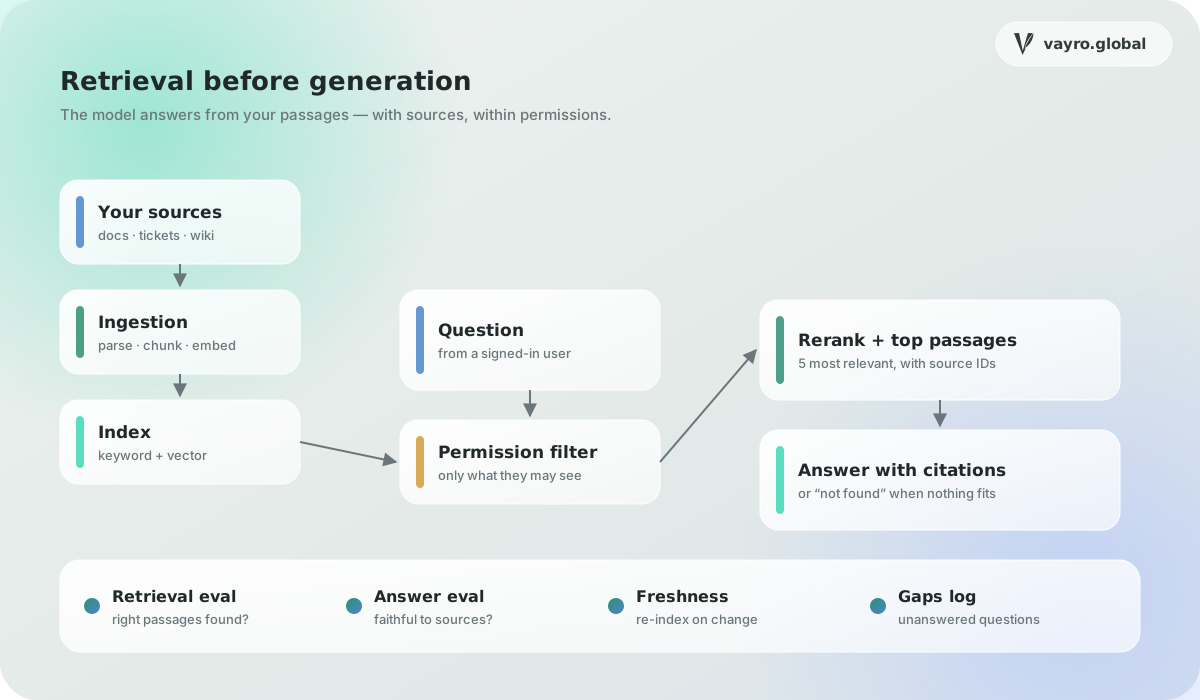
Parsing, chunking and embedding for your actual formats — PDFs, tickets, wikis, tables — with re-indexing when a source changes.
The access rules of the source system are applied at query time, per tenant and per user, and tested by trying to cross them.
Keyword and vector search combined, then reranked, because either one alone misses exact terms or misses meaning.
Every answer links to the passages it used. When retrieval finds nothing relevant, the system says so.
A question set with known source passages, so retrieval quality is a measured number that is checked on every change.
What exists, who may read it, how often it changes, and which questions people actually ask.
Real questions paired with the passages that answer them, agreed with the people who own the content.
We get the right passages retrieved first. A better model cannot fix the wrong context.
Unanswered questions and low-confidence answers are logged, which shows which documents are missing.
A paragraph about the problem is enough to start. We reply within two working days, usually with questions rather than a quote.
Engineers, designers and researchers who like systems that are hard to get right. Send something you built and what you would change about it now.
Based in India and working remotely, with overlap hours agreed up front so your team always has a time to reach us.
Guides on AI agents, RAG, MCP, tokenization and chain abstraction, written by the engineers who build them.