01
New projects
A paragraph about the problem is enough to start. We reply within two working days, usually with questions rather than a quote.
Chain abstraction: unified balances, cross-chain intents (ERC-7683), smart accounts and gas sponsorship, so users act on any chain without bridging.
Chain abstraction hides the existence of separate blockchains from the user. Instead of switching networks, bridging tokens and holding gas on every chain, a user sees one balance and states what they want — "buy this on Base with my USDC on Arbitrum" — and the system works out how. It combines smart accounts, gas sponsorship, cross-chain intents filled by solvers, and cross-chain messaging.
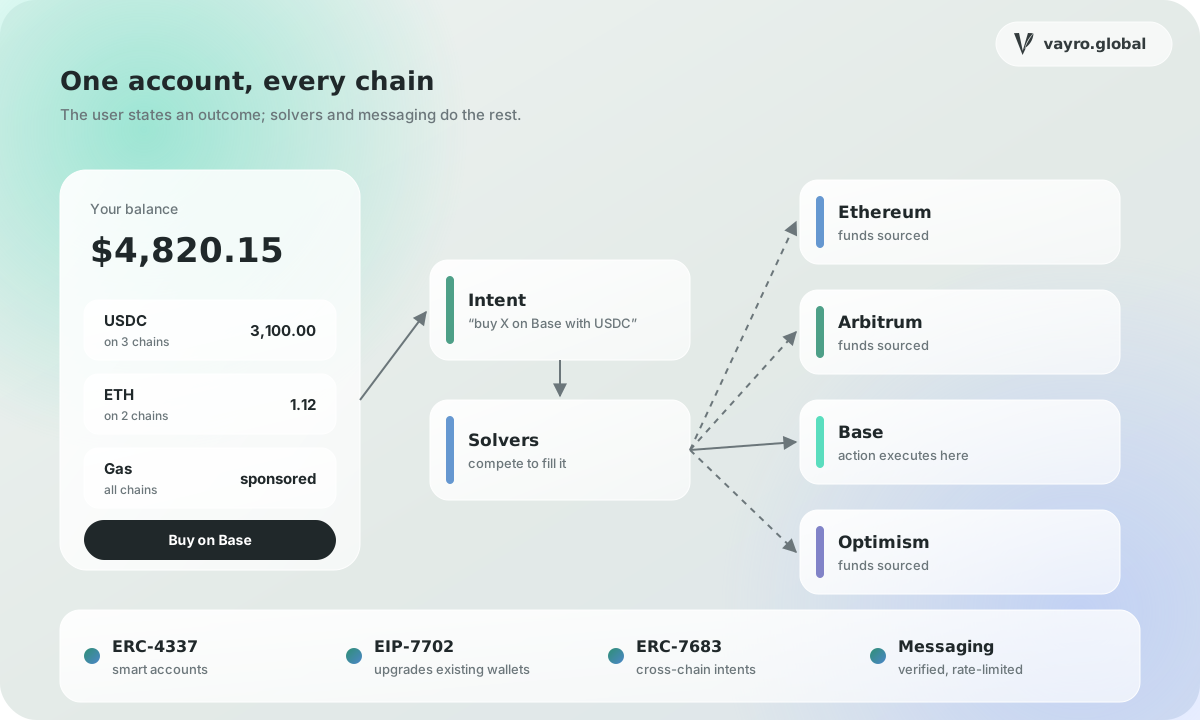
One balance per asset across chains, kept accurate by indexing every chain you support.
Users sign what they want; solvers fill it across chains. We integrate standards such as ERC-7683 for cross-chain intents and established intent networks.
ERC-4337 accounts — and EIP-7702 for existing wallets — with the same address and policies on each chain.
Fees paid in the token the user already holds, or sponsored by you, on every chain.
Messaging protocols chosen for their security model, with limits and monitoring on every route.
Every place a user meets a chain boundary today, and what they actually want to do there.
Account, intent network, messaging and paymaster — each chosen for security and coverage of your chains.
Unfilled intents, delayed messages and partial execution handled as real states, not edge cases.
Value caps per route, monitoring and a pause path before full rollout.
A paragraph about the problem is enough to start. We reply within two working days, usually with questions rather than a quote.
Engineers, designers and researchers who like systems that are hard to get right. Send something you built and what you would change about it now.
Based in India and working remotely, with overlap hours agreed up front so your team always has a time to reach us.
Guides on AI agents, RAG, MCP, tokenization and chain abstraction, written by the engineers who build them.