01
New projects
A paragraph about the problem is enough to start. We reply within two working days, usually with questions rather than a quote.
Cross-chain bridges built for security: lock-and-mint or burn-and-mint designs, verification you can reason about, rate limits, pause controls and monitoring.
A cross-chain bridge moves assets or messages between blockchains. Typically it locks tokens on one chain and mints a representation on another, or burns on one side and releases on the other. The hard part is verification — proving on the destination chain that something really happened on the source chain. Bridges have been behind some of the largest losses in crypto, including Ronin and Wormhole in 2022, so their design is mostly a security exercise.
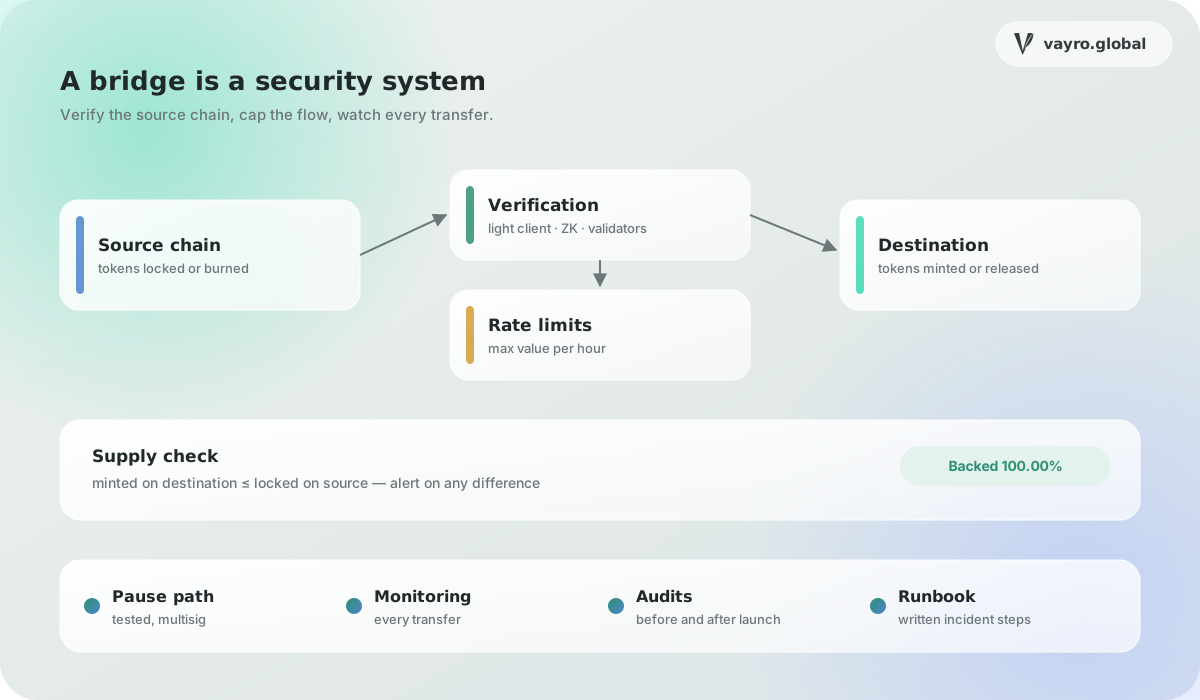
Lock-and-mint, burn-and-mint (for example a native multi-chain token) or a liquidity network — chosen for your asset and risk tolerance.
Light-client, zero-knowledge, optimistic or validator-set verification, with the trust assumptions written down plainly.
Caps on how much can move per period and a tested pause path, so a flaw cannot drain everything at once.
Continuous checks that minted supply never exceeds locked collateral, with alerts on any difference.
Real-time monitoring of every transfer and a written incident runbook.
Who could forge a message, who holds keys, and what an attacker gains from each failure.
Where an established messaging layer fits, we integrate it rather than inventing new cryptography.
Invariant tests on supply, adversarial review, and tests of the pause and recovery paths.
External audits, then launch with low limits raised over time.
A paragraph about the problem is enough to start. We reply within two working days, usually with questions rather than a quote.
Engineers, designers and researchers who like systems that are hard to get right. Send something you built and what you would change about it now.
Based in India and working remotely, with overlap hours agreed up front so your team always has a time to reach us.
Guides on AI agents, RAG, MCP, tokenization and chain abstraction, written by the engineers who build them.