01
New projects
A paragraph about the problem is enough to start. We reply within two working days, usually with questions rather than a quote.
Staking platforms: token staking contracts, native and liquid staking, reward accounting, unbonding and slashing handled clearly, with audited contracts.
Staking means locking tokens to earn rewards — either to help secure a proof-of-stake network (native staking) or to take part in an application's reward program (token staking). Liquid staking gives users a token representing their staked position that they can still use elsewhere. A staking platform has to calculate rewards exactly, explain lock-up and unbonding periods, and be honest about risks such as slashing.
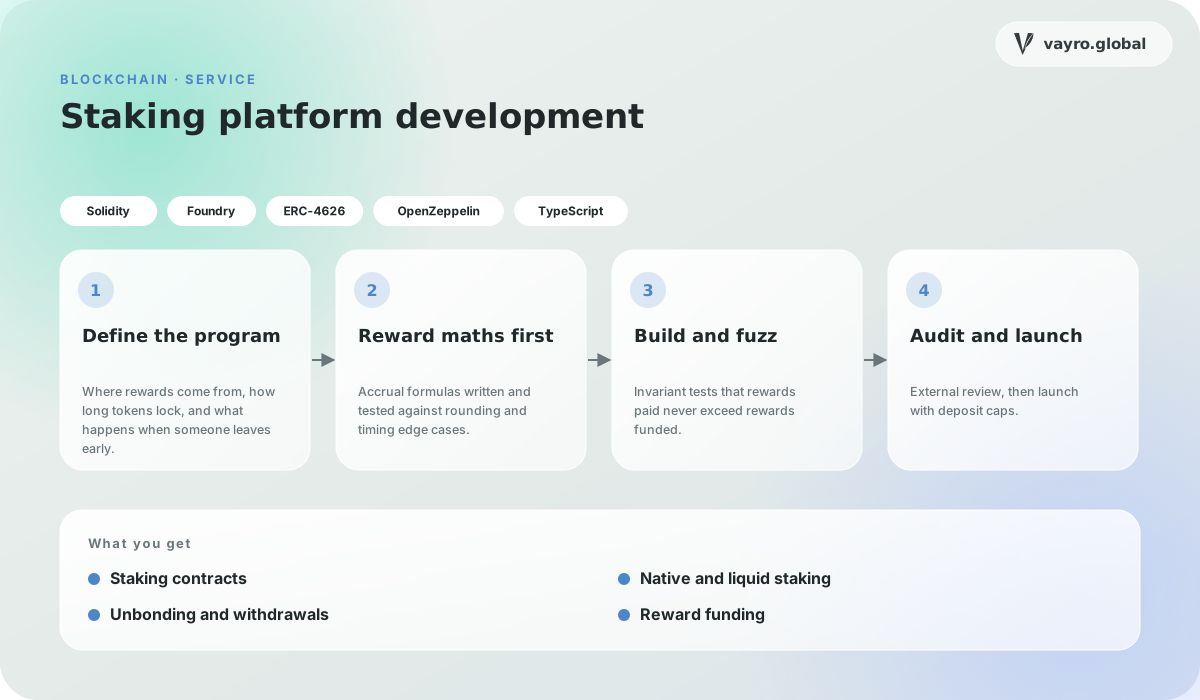
Deposit, lock and withdraw logic with reward accrual that stays exact for any number of stakers.
Validator delegation, or liquid staking tokens with clear exchange-rate accounting.
Lock-up and unbonding periods enforced on-chain and shown plainly in the interface.
Reward sources and emission schedules that cannot pay out more than the program holds.
Slashing, lock-up and smart-contract risk explained to users in plain language.
Where rewards come from, how long tokens lock, and what happens when someone leaves early.
Accrual formulas written and tested against rounding and timing edge cases.
Invariant tests that rewards paid never exceed rewards funded.
External review, then launch with deposit caps.
A paragraph about the problem is enough to start. We reply within two working days, usually with questions rather than a quote.
Engineers, designers and researchers who like systems that are hard to get right. Send something you built and what you would change about it now.
Based in India and working remotely, with overlap hours agreed up front so your team always has a time to reach us.
Guides on AI agents, RAG, MCP, tokenization and chain abstraction, written by the engineers who build them.