01
New projects
A paragraph about the problem is enough to start. We reply within two working days, usually with questions rather than a quote.
DEX development: AMM and order-book designs, concentrated liquidity, perpetuals, aggregator routing, MEV protection and audited smart contracts.
A decentralized exchange (DEX) lets people trade tokens directly from their own wallets, with smart contracts holding liquidity and settling every trade on-chain. Most DEXs use an automated market maker (AMM), where trades are priced by a formula against pools of tokens supplied by liquidity providers; others run on-chain order books or offer perpetual futures. Because the contracts hold everyone's funds, security is the product.
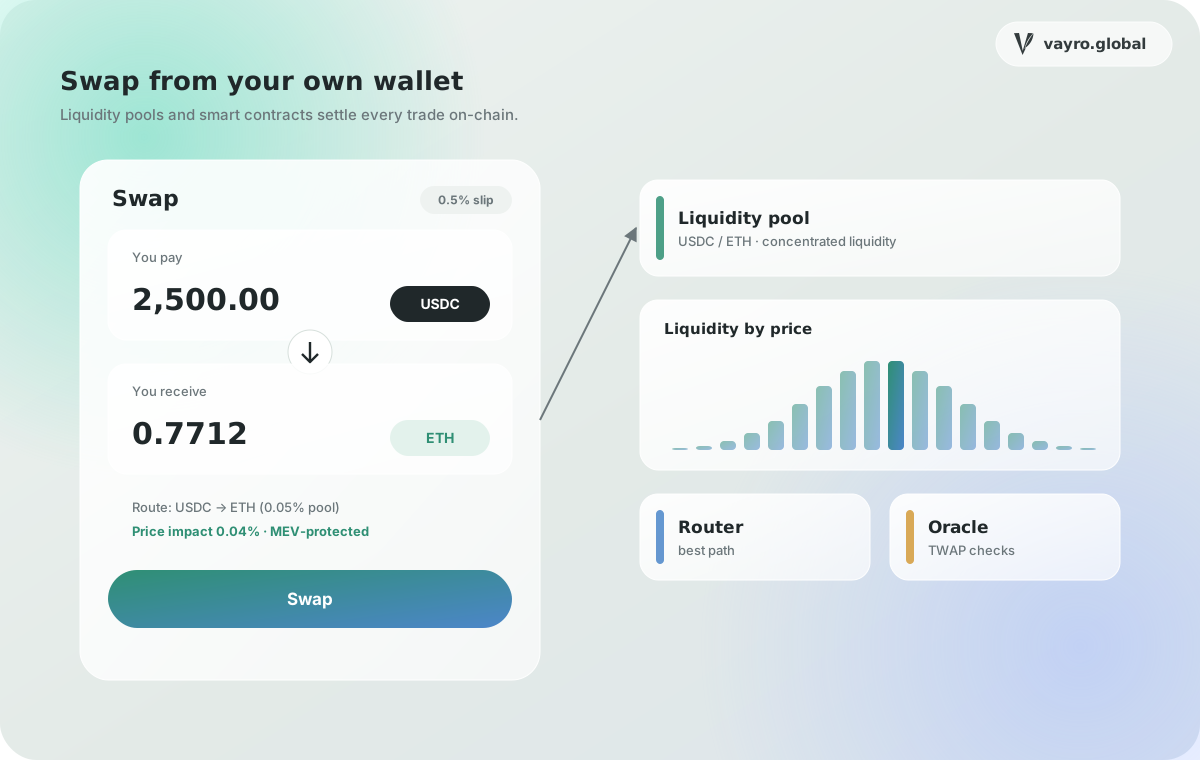
Constant-product, stable-swap or concentrated-liquidity pools — chosen for the assets you trade — or an on-chain order book where it fits.
Routing across pools and, where useful, other DEXs, with slippage limits and deadlines on every trade.
Private transaction submission and slippage controls to reduce sandwich attacks on your users.
LP positions, fee tiers and reward programs designed so they cannot be farmed and dumped.
A trading interface, an indexer for pools, prices and history, and contracts prepared for external audit.
Which assets, which pricing model, how fees flow and who provides liquidity.
Pool maths and accounting rules written down and fuzzed against the implementation.
Contracts tested against simulated trading, extreme prices and manipulation attempts.
External audit, a guarded launch with caps, and monitoring of pools and oracles.
A paragraph about the problem is enough to start. We reply within two working days, usually with questions rather than a quote.
Engineers, designers and researchers who like systems that are hard to get right. Send something you built and what you would change about it now.
Based in India and working remotely, with overlap hours agreed up front so your team always has a time to reach us.
Guides on AI agents, RAG, MCP, tokenization and chain abstraction, written by the engineers who build them.