01
New projects
A paragraph about the problem is enough to start. We reply within two working days, usually with questions rather than a quote.
Modernize a legacy system without a big-bang rewrite: a written assessment first, then incremental migration with the old path live and a tested rollback.
Legacy modernization means replacing or restructuring an old system that the business still depends on. A full rewrite switched on in one go is the riskiest way to do it. We start with a written assessment of what the system does and what it costs you, then migrate one piece at a time while the old system keeps running, with a rollback that has actually been tested.
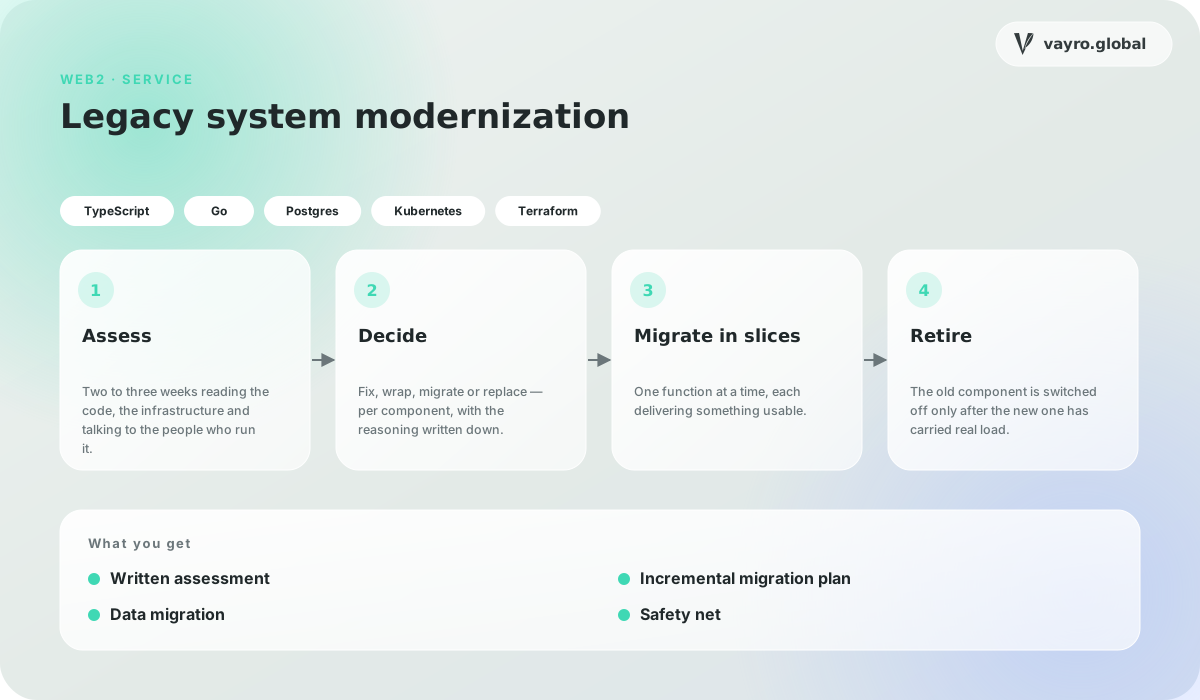
What the system does, where the risk sits, what it costs to run and change, and a recommended order of work.
A strangler-pattern route: new components take over one function at a time behind a routing layer.
Schema mapping, dual-write or backfill, and reconciliation that proves the new data matches the old.
Characterisation tests that record what the old system really does, so behaviour changes are deliberate.
Each switch rehearsed in advance, with a rollback that has been run, not just written.
Two to three weeks reading the code, the infrastructure and talking to the people who run it.
Fix, wrap, migrate or replace — per component, with the reasoning written down.
One function at a time, each delivering something usable.
The old component is switched off only after the new one has carried real load.
A paragraph about the problem is enough to start. We reply within two working days, usually with questions rather than a quote.
Engineers, designers and researchers who like systems that are hard to get right. Send something you built and what you would change about it now.
Based in India and working remotely, with overlap hours agreed up front so your team always has a time to reach us.
Guides on AI agents, RAG, MCP, tokenization and chain abstraction, written by the engineers who build them.